Comparing Apples, Oranges, and Cotton
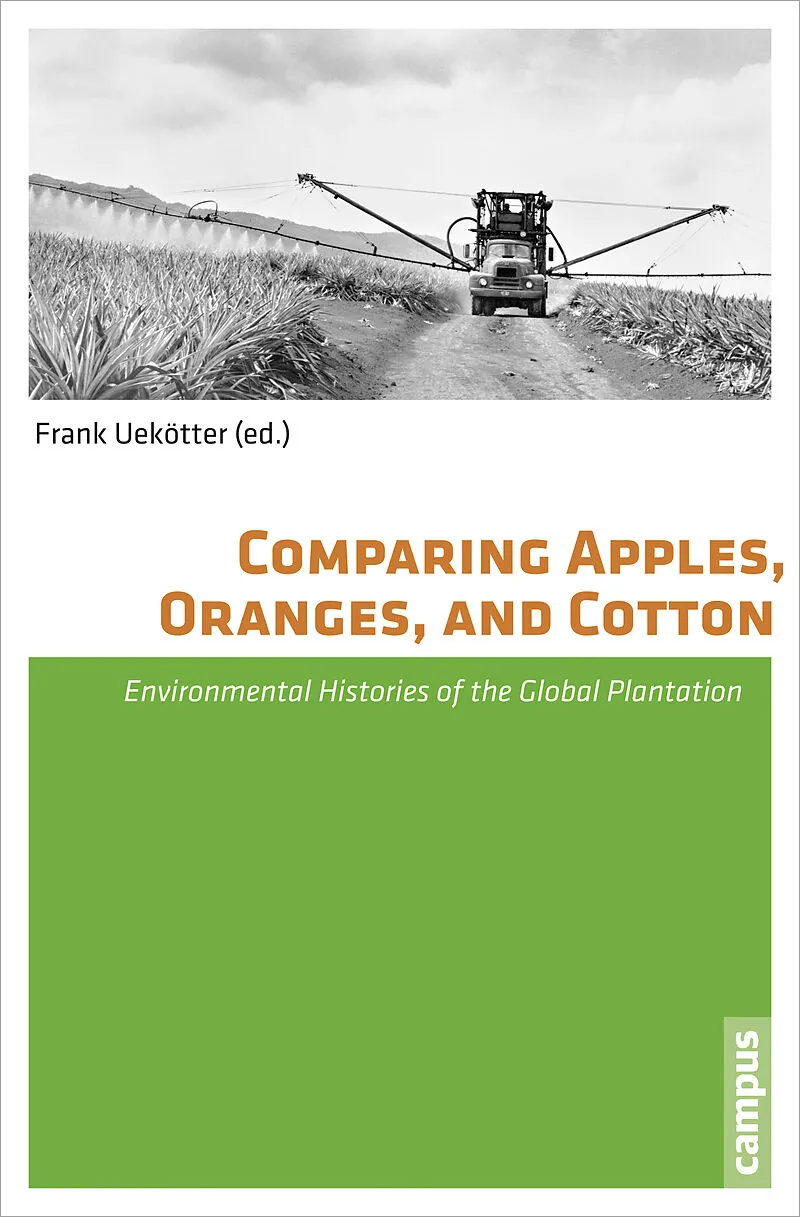
Einband:
Paperback
EAN:
9783593500287
Genre:
Regional- und Ländergeschichte
Herausgeber:
Campus Verlag GmbH
Erscheinungsdatum:
30.04.2014
Plantagen sind eine Schlüsselinstitution der Moderne. Zugleich sind sie auch in ökologischer Hinsicht eines der folgenreichsten Produktionsregime überhaupt. Im globalen Ausgriff versammelt der Band Beiträge zu so unterschiedlichen Produkten wie Kaffee, Kautschuk, Baumwolle und Äpfeln. Dabei geht es gleichermaßen um Einblicke in unterschiedliche Plantagensysteme - von Lateinamerika bis Neuseeland - wie um exemplarische Einsichten in die vielfältigen Dimensionen der Umweltgeschichte der Plantage. Die Aufsätze dokumentieren die bemerkenswerte Beharrungskraft moderner Monokulturen - aber auch den Preis, den Menschen und Umwelten dafür zahlen müssen.
»Die einzelnen Beiträge ermöglichen interessante Einblicke in ganz unterschiedliche Facetten der Plantagenwirtschaft in sehr verschiedenen geographischen, politischen und kulturellen Settings, die jedoch gleichzeitig die zunehmend globale Vernetzung der Welt widerspiegeln, die im untersuchten Zeitraum zu großen Teilen kolonial geprägt war.« Birgit Metzger, Zeitschrift für Agrargeschichte und Agrarsoziologie, 22.11.2018
Autorentext
Frank Uekötter ist Professor für Geschichte und geisteswissenschaftliche Umweltforschung an der Universität Birmingham in Großbritannien.
Klappentext
Plantagen sind eine Schlüsselinstitution der Moderne. Zugleich sind sie auch in ökologischer Hinsicht eines der folgenreichsten Produktionsregime überhaupt. Im globalen Ausgriff versammelt der Band Beiträge zu so unterschiedlichen Produkten wie Kaffee, Kautschuk, Baumwolle und Äpfeln. Dabei geht es gleichermaßen um Einblicke in unterschiedliche Plantagensysteme - von Lateinamerika bis Neuseeland - wie um exemplarische Einsichten in die vielfältigen Dimensionen der Umweltgeschichte der Plantage. Die Aufsätze dokumentieren die bemerkenswerte Beharrungskraft moderner Monokulturen - aber auch den Preis, den Menschen und Umwelten dafür zahlen müssen.
Leseprobe
Rise, Fall, and Permanence. Issues in the Environmental History of the Global Plantation Frank Uekötter Orange juice has long emerged as a staple in the American diet. It receives almost universal acclaim for its fresh taste and its health benefits, with consumption reaching across divisions of class, race, region, and gender. Florida has dominated production ever since orange growers discovered juice as an outlet for surplus production in the early twentieth century. The state of Florida established a Department of Citrus in 1935. The industry took off after the patenting of a method to produce frozen concentrated orange juice in 1948, and corporate America entered the ring: Coca-Cola bought the Minute Maid brand in 1960 while Pepsi acquired Tropicana in 1998. The Florida legislature declared orange juice the official state beverage in 1967. It may soon be over. A disease called citrus greening is wreacking havoc to an ever growing number of orange groves all over the peninsula. Caused by a bacterium, it spread through the Asian citrus psyllid, an invasive species that was first found in Florida in 1998. Citrus greening makes trees loose foliage and causes fruit to turn bitter and drop from trees before they are ripe, effectively rendering orange trees unproductive. No known cure exists for the disease, and attempts to curb the bug's spread have met with mixed success at best. The epidemic follows on the heels of a canker epidemic that cut Florida citrus production by roughly one third. After a campaign that cost $ 600 million and included felling 12.7 million citrus trees (about ten percent of Florida's commercial acreage), the U.S. Department of Agriculture found that the fight against canker was lost and cancelled its eradication efforts in 2006. In short, a tiny insect is currently pushing a nine billion dollar industry into oblivion. The story of citrus greening mirrors the paradox of the modern plantation: the combination of permanence and notorious instability. In essence, plantation history offers a deeply ambiguous narrative-a global success story full of crushing defeats. On the one hand, plantations are a cornerstone of global food production in the modern era. They have supplied societies all over the world with a cornucopia of cheap products and will continue to do so for the foreseeable future. Western consumers can barely imagine a life without oranges, apples, coffee and other plantation products, and for good reasons: they never had to worry about them throughout their entire lives. On the other hand, plantations are constantly under threat, and many plantation systems go through cycles of boom and bust. A whole host of factors can jeopardize or terminate a plantation project, and no one knows in advance whether things will work out. Of course, the environment was not the only source of trouble for plantation systems. Labor was a key issue, particularly since plantation economies hinged on slavery into the nineteenth century. The sugar industry in Brazil and the Caribbean, arguably the archetype of the modern plantation, is the best-known example. Competition is another factor. Florida's citrus industry is not only under siege from nasty diseases but also from real estate developers and cheaper producers abroad: Brazil passed Florida as the world's leading producer of oranges some three decades ago. However, environmental problems have galvanized attention long before environmentalism became a global force towards the end of the twentieth century. Soil fertility and erosion were subject to intensive debates. Pests and diseases inspired fears and frantic eradication efforts. They also inspired popular culture: the boll weevil-another tiny insect that ate its way through the Cotton South around 1900-left a mark not only on U.S. plantations but also in blues music. Scholarly Traditions Historians have discussed the role of environmental factors in plantation history long before the rise of environmental history as a distinct scholarly field in the 1970s and 1980s. In U.S. history, the boll weevil routinely figured as the nemesis of the Old South and the main culprit for the problems of the rural South in the first half of the twentieth century, thus distracting attention from other issues such as land ownership patterns or white supremacy. The Royal Botanic Gardens at Kew take pride in their role in the transfer of rubber seeds from Brazil to Southeast Asia, where plantations soon outcompeted rubber tapping in the Amazon rain forest. In 1926, Avery Craven published a book with the speaking title Soil Exhaustion as a Factor in the Agricultural History of Virginia and Maryland, 1606-1860. It attests to the Eurocentrism of historical scholarship that these early publications did not inspire a self-conscious field of study, and this volume bears the mark of a scholarly tradition that sees Europe's role in plantation history as primarily that of a consumer. In spite of the editor's best efforts, this volume does not include an article on a plantation in Europe. That is certainly not due to a lack of suitable topics. Huge orchards produce European apples and oranges, vineyards bear the hallmarks of a plantation down to a devastating phylloxera epidemic in the late nineteenth century, and a single Bavarian region, the Hallertau, grows a quarter of the global supply of hop. However, most Europeans think of plantations as an entity "somewhere else", an understanding that is perfectly in line with the word's origin. Mart Stewart's article reminds us that the plantation entered the English vocabulary with the sixteenth-century conquest of Ireland, designating what one would nowadays call settler colonization. Looking into the environmental dimension of plantations thus follows a scholar tradition, but it is a tradition that is diverse, scattered, and widely unexplored. It is also an ambiguous legacy for the discipline of environmental history. On the on…
Leider konnten wir für diesen Artikel keine Preise ermitteln ...
billigbuch.ch sucht jetzt für Sie die besten Angebote ...
Die aktuellen Verkaufspreise von 6 Onlineshops werden in Realtime abgefragt.
Sie können das gewünschte Produkt anschliessend direkt beim Anbieter Ihrer Wahl bestellen.
Loading...
Die aktuellen Verkaufspreise von 6 Onlineshops werden in Realtime abgefragt.
Sie können das gewünschte Produkt anschliessend direkt beim Anbieter Ihrer Wahl bestellen.
| # | Onlineshop | Preis CHF | Versand CHF | Total CHF | ||
|---|---|---|---|---|---|---|
| 1 | Seller | 0.00 | 0.00 | 0.00 |